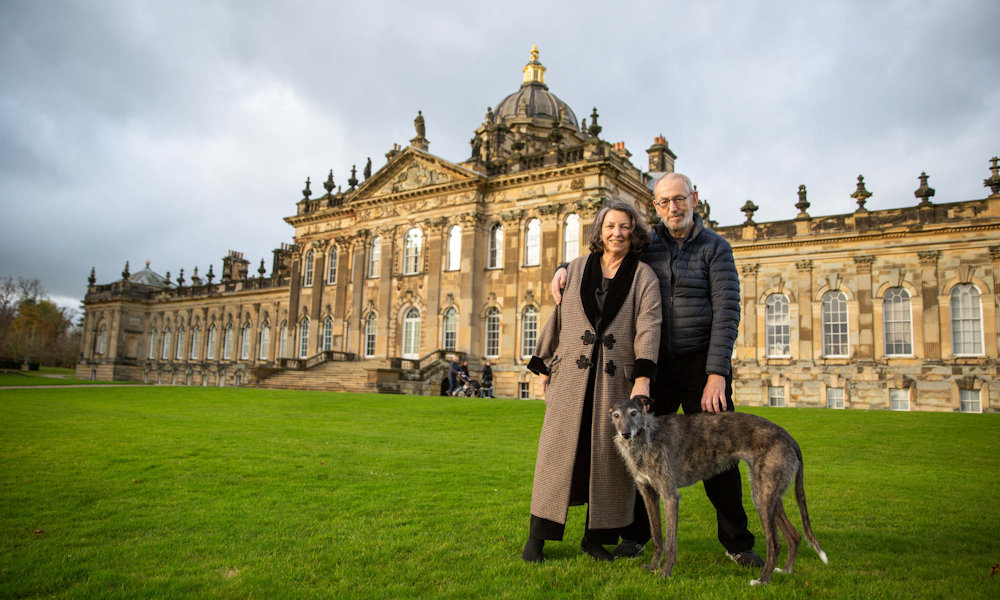
The Howard Family
The Howards of Castle Howard stem from Lord William Howard (1563-1640), youngest son of Thomas Howard, 4th Duke of Norfolk who had been beheaded in 1572. "Belted Will", as he was known, took possession of Henderskelfe in Yorkshire, the site of Castle Howard today, as part of the inheritance of his wife, Elizabeth Dacre whom he married in 1577.
Lord William's great-grandson, Charles Howard, was a skilled opportunist, an adept politician, and a successful soldier. Changing sides more than once during the course of the Civil War, he was first ennobled by Cromwell and subsequently created Earl of Carlisle by Charles II. This title was to remain in the Howard family at Castle Howard until the division of the family estates after the death of the 9th Earl and Countess.
Edward, 2nd Earl of Carlisle, sat as a Whig MP in the House of Commons from 1666-85, and he was also appointed Lord Lieutenant of Cumberland and Governor of Carlisle.
Charles, 3rd Earl of Carlisle, succeeded in 1692. Having previously sat as MP for Morpeth, he occupied various public posts, including Gentleman of the King's Bedchamber, First Lord of the Treasury and Deputy Earl Marshall.
Castle Howard was the creation of the 3rd Earl. Having spent so much time and money in building the house as a celebration of his burgeoning public life, he effectively retired to his estates c. 1715 at the age of 46. On his death in 1738 he was first buried three miles away at Bulmer but eventually interred in the Mausoleum when it was completed in 1744.
Henry, 4th Earl, toured the Continent in 1714-15 and again in 1738-39. Renowned as a connoisseur during his lifetime, he assembled the great collection of antique sculpture now at Castle Howard, as well as Italian paintings, gems and Old Master drawings. He died in 1758, having been made a Knight of the Garter the year before.
Frederick, Henry's son by his second marriage (to Isabella Byron), was only ten when he became the 5th Earl. While making his Grand Tour, accompanied by his friend, Charles James Fox, he was elected Knight of the Thistle at the age of 19. On his return to London, Carlisle was renowned for his extravagant lifestyle and his rash generosity in standing surety for Fox's gambling debts, which severely crippled the estate's finances.
However he pursued a career in public life occupying a succession of posts as Treasurer of the Royal Household, Privy Councillor, Lord Lieutenant of the East Riding of Yorkshire, and Lord Lieutenant of Ireland. By 1783 he was Lord Privy Seal, and ten years after that was elected a Knight of the Garter.
Frederick's great contribution to Castle Howard was his collection of paintings. In 1798, along with the Duke of Bridgewater and Lord Gower, he acquired the Italian paintings from the Orleans collection. Among the pictures that were exhibited in London were paintings by Titian, Veronese, Raphael, Tintoretto and many other Old Masters.
Frederick died in 1825 aged 77, and was succeeded by his son George, who had been an MP for 25 years. The 6th Earl became Chief Commissioner for Woods and Forests, was twice Lord Privy Seal, and was a Knight of the Garter. He died in 1848 and was succeeded by his son George William born in 1802.
The 7th Earl served for 17 years as an MP until defeated in 1841, after which he toured North America for a year. Twice Lord Lieutenant of Ireland, he was made a Knight of the Garter in 1855. He never married and was succeeded by his brother, William, who for more than 40 years was Rector of Londesborough in the East Riding of Yorkshire. Between 1864 and 1880 the 7th Earl's younger brother, Admiral Edward Howard, Lord Lanerton, lived at Castle Howard, owing to the 8th Earl's mental infirmity.
George, 9th Earl of Carlisle, was their nephew and the last Earl of Carlisle to live at Castle Howard. An accomplished painter, he was deeply involved in the artistic life of his day; Edward Burne-Jones and William Morris were among his many friends, and he trained under Alphonse Legros and Giovanni Costa. With his formidable and influential wife, Rosalind, he was an active supporter of the Temperance Movement, and a dedicated Liberal. He died in 1911, and his eldest son Charles, 10th Earl, only survived him by 9 months.
After the death of Rosalind in 1921, the family estates were divided according to Liberal principles. Castle Howard came to Mary Murray, their eldest daughter, who, unwilling to take it on, passed it to her younger brother, the Hon Geoffrey Howard, who was a Liberal MP and Parliamentary Secretary to Herbert Asquith, the Prime Minister.
Geoffrey died in 1935, and Castle Howard was then administered by a family trust, none of his children being of age. Of these, Mark, the eldest son, was killed in the Normandy landings, and Christopher was killed flying with the Dambusters; Christian, the eldest daughter, was created Dame of the British Empire in 1986, and died in 1999, and her sister Katherine died in 1979.
When George Howard returned, wounded, from the war, the trustees had already begun to sell the contents of Castle Howard, assuming that it was never to be lived in again. Against all expectation, he moved into the House and vigorously set about revitalising and restoring its spirit and fabric. In 1949, he married Lady Cecilia Fitzroy, daughter of the 8th Duke of Grafton. Together they opened the House and Grounds in 1952. As with so many of the previous occupants of Castle Howard, George Howard's life was divided between public service and devotion to the continuance of Castle Howard. Occupied in many causes, some were directly connected with his inheritance (such as the Country Landowners Association and the Historic Houses Association), while others were a tribute to his quick and eclectic mind (such as his Chairmanship of the Board of Governors of the BBC). He was created a Life Peer in 1983, taking the title Lord Howard of Henderskelfe, before dying in 1984.
Today Castle Howard is owned and administered by a private company, of which the Hon Nicholas and Simon Howard are the directors, undertaking the challenging tasks of running the estate and preserving the House both as a family home (now lived in by the Hon Simon Howard and his second wife Rebecca) and as the grand spectacle it has always been. Meanwhile, the next generation waits in the wings, ready to take on the challenge of the 18th century dream as a 21st century reality.